
1109
This guy plays the tune of Jason Mraz – “I’m Yours” using two Nokia Phone
this is so fucking relaxing
IVE BEEN LOOKING FOR THIS FOR TWO FUCKING YEARS
When you’re too broke to afford a Launchpad
imagine if the oceans were replaced by forests and if you went into the forest the trees would get taller the deeper you went and there’d be thousands of undiscovered species and you could effectively walk across the ocean but the deeper you went, the darker it would be and the animals would get progressively scarier and more dangerous and instead of whales there’d be giant deer and just wow
you have a beautiful imagination
entropyalarm said: When describing embarrassment, blushing is typically used as an indicator. I’m white, but I recognize that darker skin tones shouldn’t show blush the same way as lighter tones. My friend, with medium skin, told me it only shows in her nose and ears, felt more as intense heat radiating from her cheeks than a visible color change. What is your insight on handling blushing? I feel this is especially important for proper portrayal of PoCs in romantic situations.
Anonymous said: You’ve written some great advice for describing black characters, but I was wondering whether you have any advice for describing a black character blushing? I have face blindness, so I’m having a lot of trouble with this. (otherwise I could just look up pictures and describe those) So sorry to bother you!
I’m glad you’ve asked. It bothers me how often I’ve heard “Black people don’t blush” which only seems to be another way to dehumanize Black people (and defeminize Black women) for not possessing this base human reaction, even if it’s not always notably visible.
Everybody blushes. Or rather, can blush. It’s the physical act of blood rushing to the face, ears, and other areas of the body; how visible the output doesn’t dictate whether one blushes or not.
While fairness has its part, I think blushing and how visible it is has a lot to do with the individual (some folks have better blood flow) + the undertones within their skin.
I’m going to steal my undertones chart from the Skin Tone Guide here:
As shown above cool skin colors have undertones that mostly fall under red/pink shades.
I’ve seen dark cool-skinned people with naturally rosy cheeks. I can only imagine when they blush, those reddish undertones are emphasized or brightened.
On the other hand, warm skin is usually in the golden, orange spectrum. Not so much reds. Still that doesn’t mean red coloring doesn’t appear on dark warm skin tones.
I have warm medium skin with golden orange undertones, and I definitely get flushed from extrinsic factors, such as if I exercise hard (I turn a berry-red coloring), plus the winter cold pinkens my nose like Rudolph.
I’ve also had friends call me out on blushing, but I can’t tell you exactly how that looks for I’ve never checked a mirror at the time, though I imagine it’s like a slight tinting or an enrichment of the undertones in the skin, brightening them, paired with a “coral to dark red” reddening.
In general, though, it can be redundant to constantly refer to blushing to show shyness or embarrassment with characters of any skin tone. It seems blushing is one of those things that happen more often in stories than daily life. Kinda like green eyes.
For variety, also consider these indicators:
~Pages from the Emotion Thesaurus, seriously every writer should buy this book 10/10 would recommend.~
To reiterate; dark (cool) skin with red/pink undertones might show blushing more notably than warm skin, as an enhancement of those reddish undertones.Dark (warm) skin without red undertones, more “richening” of the undertones with pink to dark reddish coloring as an influence, likely depending on how harshly they’re blushing.In any case; if you’re describing the blushing from the character’s perspective, it makes more sense to focus on heat and sensation.Followers, any personal experiences or thoughts?~Mod Colette
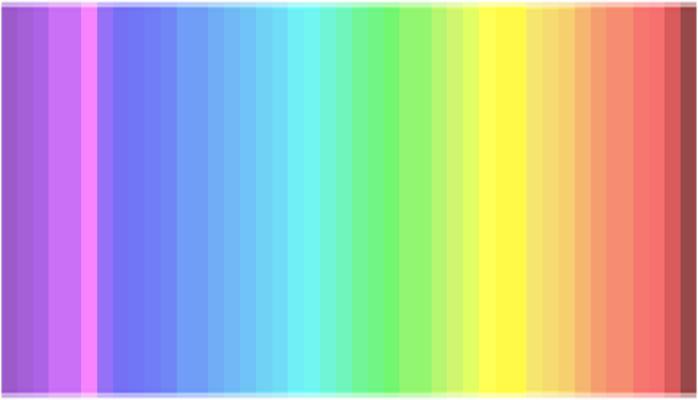
afleshjackforblainecharitydrive:
25% of the people have a 4th cone and see colors as they are
Given the sudden interest for the color of dresses and vision, here some of the fascinating findings we did recently.
The color nuances we see depend on the number and distribution of cones (=color receptors) in our eye. You can check this rainbow: how many color nuances do you count?
You see less than 20 color nuances: you are a dichromats, like dogs, which means you have 2 types of cones only. You are likely to wear black, beige, and blue. 25% of the population is dichromat.
You see between 20 and 32 color nuances: you are a trichromat, you have 3 types of cones (in the purple/blue, green and red area). You enjoy
different colors as you can appreciate them. 50% of the population is
trichromat.You see between 33 and 39 colors: you are a
tetrachromat, like bees, and have 4 types of cones (in the purple/blue,
green, red plus yellow area). You are irritated by yellow, so this color
will be nowhere to be found in your wardrobe. 25% of the population is
tetrachromat.You see more than 39 color nuances: come on, you are
making up things! there are only 39 different colors in the test and
probably only 35 are properly translated by your computer screen anyway
🙂It is highly probable that people who have an additional 4th
cone do not get tricked by blue/black or white/gold dresses, no matter
the background light 😉(x)
I see 21 colors. I had no idea there are so many more.
I can see at least 39… I’m counting more but it says there are only 39 so I’m probably counting wrong. Anyway I see 39 and yellow is my favorite color. WHAT NOW?


 AngelMihe