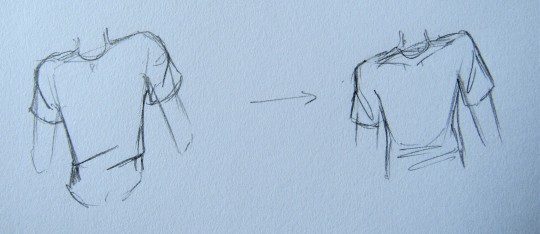
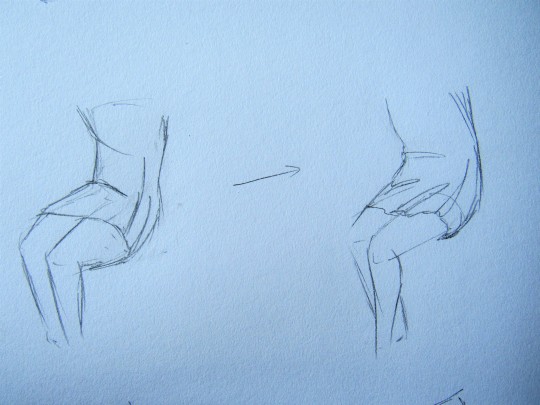
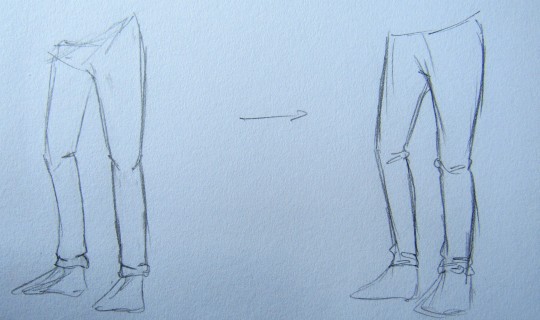
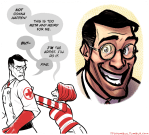
so if, like me, you’ve done all the research on how clothing folds, and you have a decent idea how the physics works, but you just can’t get it to look right?
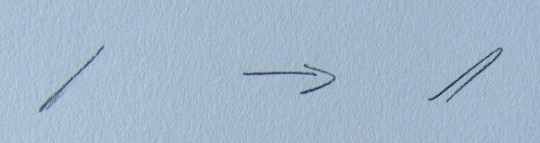
change all your lines into this
im serious
it makes everything look so much more natural
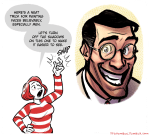
for added realism, just add random bumps to the line wherever you put one
and there you go!
(please dont judge me for my anatomy i drew this in five minutes)
Well, I can give you some tips based on how I do it. Your mileage may vary.
I mainly figure out where my dudes’ hairlines are supposed to be based on the physical landmarks of the head. Here’s a generic head I drew up that highlights those parts. It’s not realistically accurate since these are TF2-ish proportions, but it does involve knowledge of actual anatomy, which isn’t as scary as it sounds.
1-3 are self-explanatory. 4 is that slight bony ridge around that little depressed area behind your forehead on the sides. 5 is the bump of the base of your skull where it meets your neck muscle.
Also, notice where things line up, since these are clues to help you lock things in place and keep facial features from floating around too much. For example, the top of the ear generally lines up with the eyeline and the bottom with the mouth. There are lots of little tricks like that.
And here’s a generic hairline based on these landmarks.
Of course, reference is also going to help you out a bunch here. The above approximation is just meant to give a basic idea of where a hairline would be. Like fingerprints, everyone’s hairline is unique. Depending on your character, you should feel free to mix it up!
These are just a few slight variations, to give you an idea of what I mean: rounded, pointy, and receding. Once I have my hairline roughed in, I pick where the hair part is (if there is one) and sketch in the hair, following the natural growth pattern of hair.
You can get nearly infinite variations! Get wacky with it! And there’s no one 100% correct way to draw a hairline (or anything else, for that matter) so don’t get too hung up on not doing it wrong. Practice until you’re comfortable, and you’ll be winging it in no time.
Check out the Exercise and Download the Practice Sheet HERE.
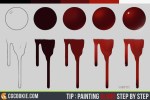
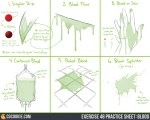
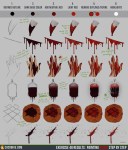
You know that saying, “blood is thicker than water“, well that applies to drawing it as well! Read the full explanation and tip guide on how to paint blood for your own works. You can download the pratice sheet .PSD in the link above along with both step by step guides!
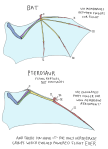
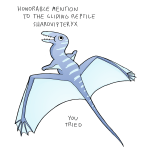
ANOTHER ANATOMY POST! Only three vertebrate groups have successfully evolved flight: Birds, Bats, and Pterosaurs, which are NOT dinosaurs, and are an extremely diverse group of reptiles! Pterodactyl is not the only one. However, birds ARE dinosaurs. Avian dinosaurs!
Wings are not some extra structure you tack on to a creature and somehow the arms go away— they ARE arms. Think about that when you are designing creatures with wings and also giving them arms. That means your creature has six limbs.
Next anatomy post: The anatomy and evolution of DRAGONS. If you guys have any requests, feel free to send them in!
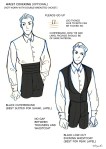
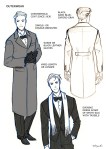
I’ve been studying the classic black tie dress code (mainly from here) so I thought I could share my notes. Maybe they can be helpful to someone else, too. If I made any mistakes or things are really confusing please tell me. I also have some notes on white tie which I could share as well…
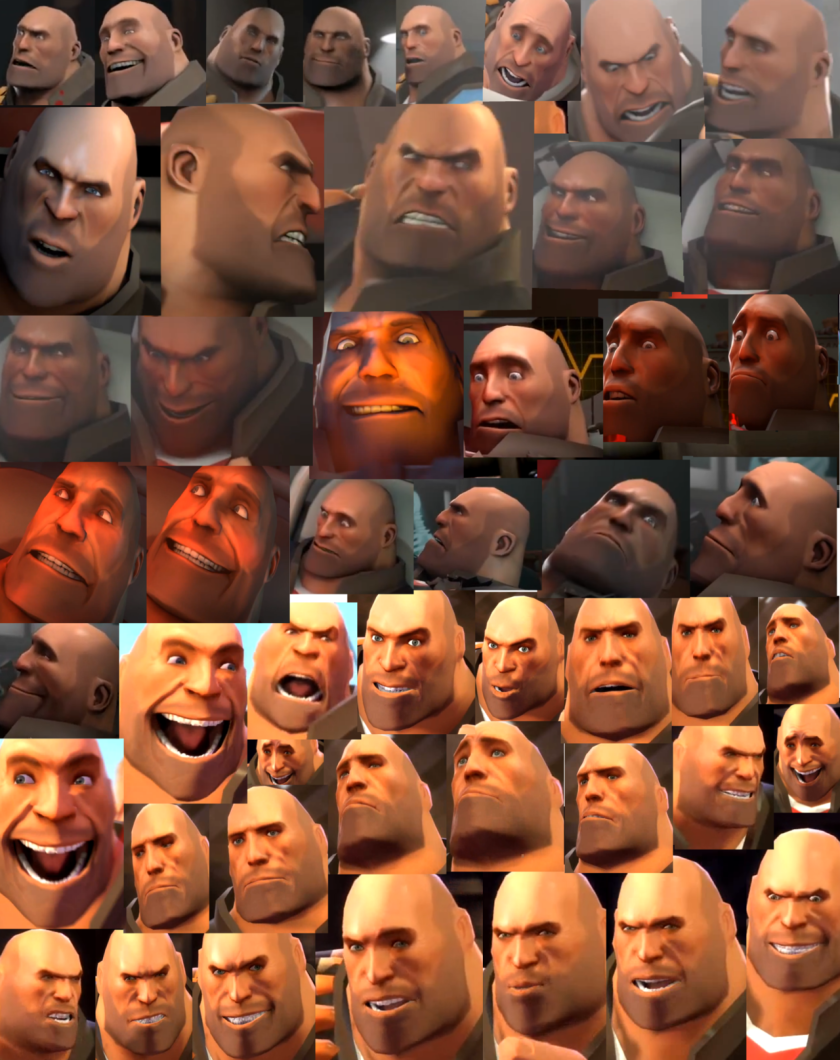
Huge medic expressions screencap dump! Putting these up for other people to use as reference XD I’m using them myself to get used to his range of emotion, which is VAST. look at these! he has the most expressive face every split second is wildly different to the last, God i just love this character, He’s so much fun!
German Language: Hello! What’s going on? All good!
The German is a rich language and spread around the world. But the language proficiency in the immigration country Germany is currently bad. A guest post.
08.11.2016, Roland Kaehlbrandt
The German language is regaining importance. The Goethe-Institute noted a growing interest in the language courses abroad.
Also far from the core countries of the German language community,
the interest in the language of Goethe increases, e.g. in Brazil, Vietnam
or China. In Germany itself currently the unanimous opinion prevails that the German language must be imparted as fast and as far as
possible to the many immigrants who on a daily basis flock into the country from foreign cultures and different linguistic communities. The mistake of the sixties and seventies should not be repeated, because many immigrants would probably not return to their home countries.
But isn’t learning the German language an imposition? Who is browsing the book “Words and Rules” by the Canadian-American cognitive scientist and linguist Steven Pinker, encounters a
particularly amusing chapter. It is called “The horrors of the German language”. It is all written in the spirit of that famous quote attributed to Mark Twain
or Oscar Wilde: “Life is too short to learn German.” Pinker stoops over the verb forms and plurals of German nouns and finds an in his opinion frighteningly large wealth of forms.
When reading this as a native German speaker, one is almost tempted to look up to oneself
in view of the fact that one has obviously to be particularly intelligent in order to effortlessly master this wealth of forms. But at the same time you think in compassion of all those who need to learn that. The elsewhere heard verdict keeps lingering in the memory that the
German language was difficult, complicated and inaccessible – and therefore inferior as a foreign language and even as an international language, or inferior to English as a language of science.
German: Language for the good students?
The verdict about the “difficult” German language has for instance led in France to the classification of German next to Latin or ancient Greek as a language “pour les très bons élèves”, for particularly good students. It is also anything but helpful when it comes to motivate people to learn or – in the own country – to maintain German. But is this language really so difficult, complicated, impenetrable, hardly accessible?
German has a very large vocabulary. The report on the situation of the German language from 2013 lists a stunning number: 5.4 million words. Why is the German vocabulary so extensive? Due to its almost unlimited combinability. German downright invites you to compose new words from existing ones. It has therefore been called the Lego language.
The advantage: Usually, you can immediately read out the new meaning of the compound words. Based on the knowledge of the meanings of Kind (child) and Arzt (doctor), one understands the meaning of the new term Kinderarzt (pediatrician) at the first glance. Once one has found the combination of child and doctor, one is able to construct and understand all other names for the medical professions: Frauenarzt (gynecologist, die Frau = woman), Zahnarzt (dentist, der Zahn = tooth), Tierarzt (veterinarian, das Tier = animal), the span even reaches to the complex Hals-Nasen-Ohrenarzt (otolaryngologist, der Hals = throat, die Nase = nose, das Ohr = ear). This way the German vocabulary can be expanded. This is also ideal for scientific and technical terms.
(Of course, this tempts to create monster words like Finanzmarktstabilisierungsgesetz (Financial Market Stabilisation Act). But at least everything is under a single roof.)
Language must be able to put a changing world into words
I like to collect new words, and often, I discover combinations like this. Two new creations came to my attention when reading this newspaper. One is the Wildpinkler (literally: wild wee-er, one who pees in the open). He opened at once a wide semantic field, for example, the Wildparker (someone who parks his car where it is not permitted). Whenever someone puts something into the countryside, or makes his presence annoyingly felt in non-designated areas, then the prefix wild- can now be used
A creation of a Frankfurt suburb fits to this series: the Fremdhund (foreign dog). Foreign dogs are in the first place stray dogs, but in a new linguistic usage they are dogs, which are not walked close to the owner’s home to do their business, but rather onto the meadows of the neighboring village. Given the moral decline with regards to waste and other externalizations, the
German offers perfectly suitable, flexible techniques of denomination. A great advantage, because a language must put the world into words, however it may change.
Another example of effortless word formation is the Erfahrungsjurist (lawyer by experience) how some time ago Bavarian Prime Minister Horst Seehofer called himself. What may now follow? The Erfahrungsökonom (economist by experience), the Erfahrungsgeneral (general by experience) the Erfahrungsanleger (investor by experience) or the Erfahrungsanlegende (female investor by experience). In any case, German is very productive in creating new types of people, and the easy combinability helps: New words from the two-thousands are the Mautpreller (toll evader, die Maut = toll, der Preller = someone who skips out on the bill), the Mietnomade (rental nomad, mieten = to rent, der Nomade = nomad), the Frauenversteher (man who knows to read women, die Frau = woman, verstehen = to understand). A recent one is the Russlandversteher (someone who shows tolerance and understanding towards the recent escapades of Russian foreign policy).
Propensity to combination creates accuracy
The propensity to combination of the German language facilitates accuracy of expression. Take the word family of the verb gehen (to go). What a wealth of placements in space can you find there: angehen (to start, to concern, to come on; an = on), ausgehen (to end, to finish, to come off, to leave the house; aus = off, from), weggehen (to go away; weg = away), aufgehen (to rise, to open; auf = up, open), abgehen (to exit, to leave, to go off; ab = down, off), entgegengehen (to go to meet someone; entgegen = towards), untergehen (to sink, to set; unter = under), hinaufgehen (to go upstairs, to go uphill; hinauf = upwards), hinuntergehen (to go downstairs, to go downhill; hinunter = downhill). The semantic field of motion verbs and the verbs of movement in the
German language is huge, for example, the verb laufen (to run) with its derivatives anlaufen (to start), entlaufen (run away), verlaufen (to get lost), überlaufen (to run over, to defect), entgegenlaufen (to run to meet somebody), unterlaufen (to circumvent, to subvert), and so on. One may fear this accuracy, especially when it comes to words like herunterfallen (to fall down towards a reference point) or hinaufsteigen (to climb up away from a reference point), or you can admire them. At least, they are easy to produce and to understand
In addition, the combinability of the German vocabulary produces beautiful words, which by the combination of simple syllables creates a very special new meaning: anschmiegsam (cuddly, affectionate, slinky, soft and smooth), unantastbar (inviolable, unimpeachable), and unnahbar (unapproachable) belong to these
beautiful words.
My favorite word is anschmiegsam. It is a genuine linguistic work of art. Anschmiegsam is made from three simple words: At the core of the word, there is the verb sich anschmiegen (to nestle, to snuggle, to cling), then the adjective suffix -sam, which makes it possible to convert a verb into an adjective, and in the verb itself the prefix an-, which additionally emphasizes the spatial closeness between two persons (in contrast to other prefixes like auf- of ab-). Anschmiegsam is not only beautiful in its gesture, but also in the acoustic pattern. Furthermore, there is the differenciation in its meaning in contrast to formally related verbs, such as anlehnen (to lean against). Anschmiegen is not just leaning against someone, but it expresses an even greater closeness, almost intimacy.
Compositions of this kind enable the German language to denominate and ultimately create so many fine differences. In the word formation, we generate linguistic and intellectual creations. They are by no means trivial, even though they come naturally to us. Word formation is an elementary process. Beause we learn about our world in words, we define our world in them, and we talk about our world with them.
The sentence structure: Merit oder impertinence?
One more merit of the German language is the sentence structure. Sentence structure, a merit? What have you not heard about the German sentence! It would be complicated. It would invite to lengths. It would follow an unnatural order by dividing the verb by the verb bracket and putting the verb at the end of a clause.
The verb or sentence bracket originates from the helper and modal verbs, which specify the meaning of the main verb, like in the sencence: Paul soll Karl gestern Abend gegen 19.00 Uhr auf dem Bahnsteig von Köln-Ehrenfeld nicht gesehen haben. (Paul is said to not have seen Karl yesterday evening around 7 p.m. at the platform of Köln-Ehrenfeld station.) The bracket reaches from „soll“ until „nicht gesehen haben“, and many a foreigner moans in annoyance about the long distance he has to cover until he has understood the true meaning of the sentence, because it is not revealed until the very end. But you may circumvent the sentence bracket by forming two sentences: Gestern Abend stand Paul um 19.00 Uhr auf dem Bahnsteig von Köln-Ehrenfeld. Da soll er Karl nicht gesehen haben. (Yesterday evening, Paul was standing around 7 p.m. on the platform of Köln-Ehranfeld station. He is said to not have seen Karl.)
But the verb bracket has also its good sides. Because the contents of a sentence is brought into line only at the verb part at the end, a synthetic picture of the situation is being formed: The contents of a sentence is condensed into one picture; into a picture which enables someone to conceive in one moment all elements of a sentence in their mutual relationship.
But now to the central benefit of the German sentence structure: It is very flexible. You can turn and twist a sentence like „Ich habe ihm das Buch geschenkt.“ (I have given the book to him.), and every time it is getting a new nuance. If you would like to emphasize the recipient, you may say “Ihm habe ich das Buch geschenkt.” If you want to emphasize the recipient a little less, you may say: “Ich habe das Buch ihm geschenkt.” If the gift itself needs to be emphasized, it is: “Das Buch habe ich ihm geschenkt.” And who wants to clarify that the book was not sold or borrowed, says: “Geschenkt habe ich ihm das Buch.” The benefits of the German sentence structure are nimbleness and richness in nuances.
So we don’t go like a bull at a gate
A less familiar advantage is the inherent shading and tinting of requests or question. An example: We see the child of the new neighbor for the first time. How do we ask for his name? „Wie heißt du?“ („What’s your name?”) That would be quite curt. So we say: „Wie heißt du denn?“ This way, the question is more conciliatory, extenuated, cushioned. One is asking, but at the same time one apologizes a little bit for asking.
It is a subtle additional meaning, which the German language offers, and which eases the task to fine-tune the communication intent towards the other and towards the message. These little words are called „Abtönungspartikel“, modal particles. The linguist Peter Eisenberg calls them admiringly “wrens in the fur of language”. They give a certain note to a question or remark, they help to avoid going like a bull at a gate with a raw statement or aith a direct question.
Fortunately, we have many of these little words at hand like aber, auch, bloß, doch, eben, halt, etwa, ja, schon, vielleicht, wohl. „Mach’s halt!“ (”Just do it”), says the father to the son, who does not default the mother’s demand to finally clean up the room. There is something companionable in this „halt“. It denominates a good advice; quite different as if the simple, crude order „mach’s!“ had been expressed. Thus, the German language is apt for relations. It offers the possibility for a highly sophisticated balancing of social actions.
Short words, long sentences
Certainly, the German sentence enables you, if you wish, to place nearly unsurmountable sequences of words in front of the referance noun, creating long-winded formulations: “Ein zwei Meter langer, aus dem Nachlass des vor vielen
Jahren in unserer unmittelbaren Nachbarschaft ansässigen und dann, wie
bereits angedeutet, aber nicht konkret ausgeführt, leider verstorbenen
Erfinders übernommener, aus dunklem Mahagoniholz gefertigter wuchtiger
Esstisch…” (A two meter long massive dining table made from dark mahogany from the assets of the inventor, who was living many years ago in our immediate neighborhood and who sadly has later died, as already implied, but not specifically explained, …) But is the length a natural law of the German language, as classical jokes about the European languages and the habits of their speakers suggest?
Wolf Schneider, knowledgeable disciplinarian of the German journalists, has shown in a comparison with the English language that many German words pass the contest of shortness well. He names for example Trödler vs. second-hand dealer or Trost and consolation.
Of course, there are ample numbers of opposite examples. But the University of Applied Sciences does definitely not belong to them; the nowadays swiftly pursued renaming can certainly not be justified with the length of Fachhochschule.
That there is language economy also in German and that it even enables the absolute short form (a term from the consultant’s jargon), shows itself in colloquial German. In the recent years, a number of fixed idioms has developed. Spontaneous German, such as „Hallo!“ (Hello!), „Was geht?“ (What’s up?) or „Alles gut!“ (All fine!) allows for a short, quite emotional minimal dialogue in any situation. You can think of such everyday language economy what you like, and you don’t have to talk up spontaneous German to the new high-level language. But the claim, German would not allow for a concise diction is simply wrong.
The native language determines whether German is easier or harder
Big vocabulary, flexible and transparent word formation, highly differentiated sentence construction with elastic word order to express subtle differences in meaning, aptness for relations, quite surprisingly even the ability for succinctness – these are the merits of the German language. One could also say something about the rather dark chapters of our language construction: about the chaos in tenses, about the confusing noun classes, or about the declination of nominal groups, just like Steven Pinker or Mark Twain did. But you can find complexity in any language. Apart from that, the valuation of a language structure as complex or simple also depends on the native language. Native speakers of slavic languages perceive the degree of difficulty differently than Britons or French.
Who talks about the situation of a language wants to know how well it can be used. And to do that, one has to ask how widely it is in use. Because – that’s how one could summarize a kind of language prevalence law – the more people speak a language, the more useful it is and in turn the more people want to learn the language. And the more a language is spoken and learned, the better it can develop, because it can imbibe new things again and again, thereby continuing to be a suitable means of expression. Many states have recognized it, thus they promote an active language export policy.
103.4 Million native speakers, official language in seven states
Now, how widely is the German language used? German has 103.5 million native speakers, thus being among the ten strongest languages of the world. That is quite far at the front, given that there are about 6000 languages. In the EU, German is the most widely spoken native language. About one third of the Europeans have knowledge in German as a foreign language. German has the status of a national or regional official language not only in Germany but also in seven states: apart from Germany also in Austria, Belgium, Italy, Luxemburg, Switzerland, and Liechtenstein. There are also many native German speakers outside of the area where it is an official language: 7.5 million worldwide. For example, there are strong German-speaking communities in Brazil (1.1 million), in the USA (1.4 million), in Canada (500,000), in South Africa (500,000), but also in Poland (600,000) and Russia (750,000). Even in the Dominican Republic (30,000).
For the status of a language, it is also very important in which amount it is leaned by others. At the moment, 15 million people in 114 states learn German. If you add up all living individuals, which have studied German in any way during their educational carreer, you end up with almost 300 million. They form a huge potential for the foreign language policy.
So, German is a fully developed, rich language, in addition one of the most widespread languages of the world. But it does not look particularly well when it comes to language proficiency in the own country.
The command of the erudite language German is anything but satisfactory. Knowledge of correct spelling is decreasing. Today, primary-school pupils make almost twice as many spelling mistakes as in the 1970s. The reading skills are quite unpleasant: According to the German Reading Foundation, in all of Germany, 7.5 million adults between 18 and 64 years are not able to properly understand texts and to properly write. School entry examinations show that 40 percent of the children of immigrants lag far behind the requirements for first-graders. From the senoir grades and the seminars at universities, there are reports that the spreading between good language skills and fragmentary command of the German language is increasing.
Anglicisms will not kill the German language
And how does the language develop, or: How do the Germans, its speakers, develop it? Surely one can be worried about the widespread inclination that almost everything that is somehow “hip” is named in English, film titles, book titles, technical products, meanwhile even city districts – although German is outstandingly suited to designate new things as the examples of Schnittstelle (interface), herunterladen (download), Datenautobahn (information superhighway) show. Nevertheless, the inclination to anglicisms will hardly kill a big language like German.
Other tendencies to entirely replace German in some fields, such as parts of the academic or economic life, are yet more risky. Advocates of English as global language for everyone take the view that this would not be a loss as culture and language were not dependent on each other: you may read Kant just as well in English. According to that, our culture would be so independent from our language that one could give it up in favor of a global language.
But is language not culture? Of course, many things are translatable. But languages are not exchangeable labels that one can stick onto precast ideas. Language and thinking influence each other, even though languages are no mental jails. There are cultural treasures resting in the languages: Specialities of the linguistic structures and expression, stylistic delicacies, differently arranged paradigms of meaning, liguistically set manners, a special liguistic humor, not least: literature, poetry and the associated traditions, in summary identity. The Australian linguist Nicholas Evans has written in his recently published book about the extinction of languages and what we are thereby losing: “The loss of our linguistic heritage is tightly coupled with the loss of cultures and living environments.”
How we can keep our language alive
What can we do to vitalize the German language that it is up to future challenges? All school teachers should be introduced in the subject of German as second language. Otherwise, an effective language education cannot be accomplished in the light of massive immigration. Lessons sentitive to the language is neccesary, also in other subjects.
Generally, more attention has to be paid to language education: This concerns especially exercises in grammar, vocabulary, and spelling. Experienced teachers pledge for exercises up until upper classes. High high requirements concerning the language are not per se ostracizing so one should better avoid aiming at them. On the contrary, in a highly developed society they must be an educational objective.
German should be preserved as a common language at universities. Otherwise, linguistic islands appear, which are detrimental for the important contact between science and society. Foreign students should in any case be able to learn German. At least in the social sciences and humanities, German should be maintained as a scientific language.
Magical cure: Masterpieces in German
The best means to keep the German language attractive, at home as well as abroad, are however technical-scientific, economic, and cultural masterpieces. But the willingness must be added to name the masterpieces in the language of the society that has created them.
Language education is not the task of school and state. Language education is the task of the entire language community. Associations, foundatins, citizen’s initiatives are active in language cultivation. That is a good sign. Because the state allone will be unable to do the job. And much less when it comes to the integration of the many people who are seeking refuge and future in Germany.
It is gratifying that the civil societs is so active in conveying the German language: Many citizens of all possible occupations and origins have volunteered to teach German. New textbooks to make good teaching materials available to the honorary language mediators are constantly being published. Foundatins are active to pass on their long-term experiences in the area of support in the German language and to adjust to the new situation in the immigratin country Germany with own language programs. Insofar, the hope is justified that especially in view of the new immigration the importance of the German language will be better recognized – simply because reality is so compelling.
Maybe the future of our quite learnable and still widespread language also lies in the hands of those who come to us from the outside to find a new home in our country – and who will later appreciate German as the language of their newly found safety and freedom.
So I’ve seen this post going around in link form, which isn’t super useful to anyone who wants to read it, so I put it up in photo form. Useful for anyone who doesn’t have xkit. :3 Definitely like and reblog the OP, but if it shows up as a link, this helps. :3














 AngelMihe