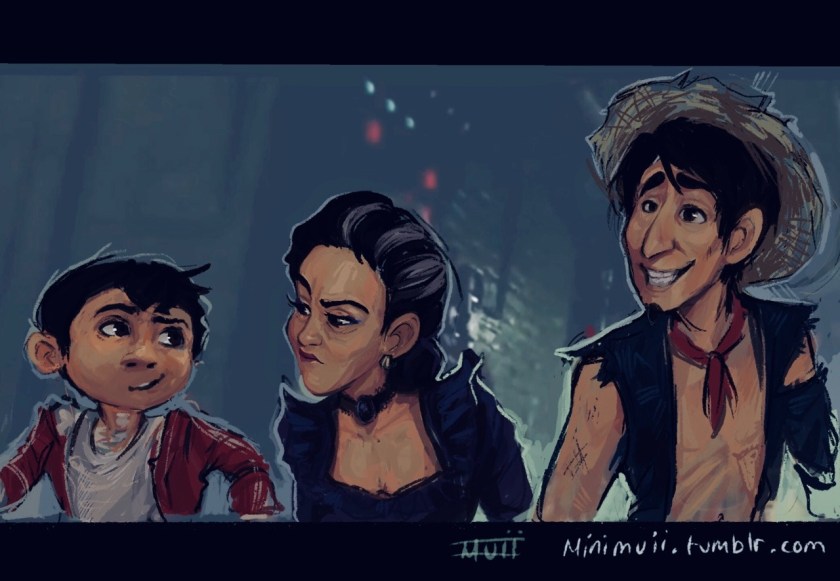
HAPPY BIRTHDAY HÉCTOR!!💀🎉 and to his voice actor as they share the same birthday 😊😊 Happy birthday to most amazing skeleton dad and man to ever walk this earth 💖💖 WE LOVE YOU SO MUCH 💖💖
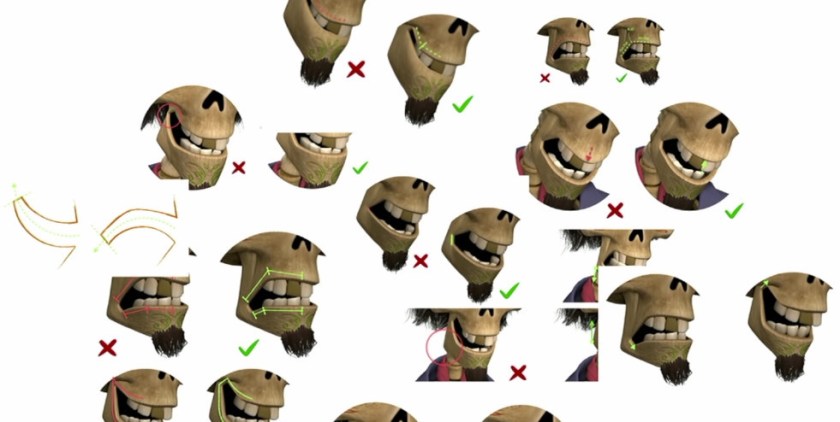
I totallyyyyy recommend watching this video! It explains all the hard work the animators did to find the animation just right for the skeletons! Also along with explaining the complicated situation with Héctor’s mouth gap lol!
Psssst…! In one of the animation tests… Hector steals an apple 😉 🍎
I expected Coco to be a very charming and beautiful film that I would really enjoy, and it was!
What I didn’t expect is that it would be a meditation on the importance of record-keeping, ethical archives, and proper attribution. But it was, that, too! And it was that in a really careful and aware way that surprised me a little.
(Keep in mind that I am a mere librarian and certainly not an expert on archives in any way, so there’s probably a lot more to be said about this from an expert point of view.)
But let’s think about this for a moment. The central injustice in the film that must be corrected isn’t the conflict between Miguel and his family (they work it out). Instead, it’s a crisis of misattribution. Hector is a genius songwriter, but his work has been inaccurately attributed to Ernesto de la Cruz. Interestingly, De la Cruz has also murdered him, which was obviously a bad thing to do, but the crisis that we face in the film stems much more directly from the plagiarism than it does from the murder. Because his work has been stolen by someone else, Hector has been forgotten, abandoned. The film sets up a mythology that makes it clear that being forgotten after death is itself a kind of death (the ultimate death, really), which means that when de la Cruz takes his work in that way, and uses it to make himself rich in the afterlife… that is, itself, almost a second murder.
A brilliant colleague of mine once said: “Information has value because people have value.” Remembering Hector for his work is important, because Hector is important.
But there’s more to it than that. The film makes a distinction between public memory and private memory. Tributes from fans are nice to have, but what really matters – the thing that lets spirits visit the living – is the family ofrenda. A major part of Miguel’s journey in the film is to realize why the ofrenda is important and what it means to be part of a family that is committed to remembering the dead. But what is remembered is also really, really important. Hector makes this distinction between his songs “for the world” and the song “Remember Me,” the one that became so famous, which he had really written for Coco alone. And looking back after all the plot twists have been revealed, it becomes very clear why he doesn’t want Miguel to play it for the crowd and why he winces at its popularity. It’s an intimate family memory that’s been made public and stripped of the personal meaning it has for him. It’s not just (at least from an audience perspective!) that it’s emblematic of the tension for him between “playing for the world” and staying close to his family. It’s the perfect encapsulation of the way that information (works of art, documents of all kinds) change their meanings in different contexts, and the importance of intimate documents in that intimate context versus in public.
WHICH IS WHY the ending of the movie was so moving for me. Coco has everything she needs to create the necessary archive that will commemorate her father’s work, and with the help of her family, she does – but she creates it right there in the village, where Hector’s family lived, not away in some big city university or more official archive. Although his music is internationally famous, the people who really need to remember him are those who are intimately connected to him, and whose memories of him have been distorted and have faded. (Imelda is an interesting figure in this respect. (I love her though)) And what we’re left with, aside from that beautiful wall of letters and song lyrics, is the recognition that records must be preserved within the community in which they originated. Indeed, I’d argue that the film is an argument that the people connected to someone are those who are best equipped to organize, present, and interpret their records.
(I do wonder whether they consulted a professional archivist about preservation techniques, though. Those papers are pretty old! I wouldn’t want them to fall apart!)
…I MAY also have been a little impressed by the film’s invitation to learn more about Dia de Muertos in a library, but it’s really involved in knowledge preservation in a much deeper way.







 AngelMihe