if you’re american and coming to australia, I’m gonna go ahead and say that you should be 100 percent way more worried about being king hit by a dude named “dane” in a bintang singlet than any fucking spiders that exist here
what does this say in english
“Good sir, if you are a resident of the United States of America and coming to visit the sunny land of Australia, allow me to inform you that you should be rather more concerned about being sucker punched by a gentleman named ‘Dane’ who is likely to be seen wearing a wifebeater with a beer company logo on it than by any of the dangerous spiders that exist on this lovely continent”.
ok so what does it say in american
“You’re more likely to get sucker punched/cold-cocked by an asshole than you are to be bitten by a spider”.
thank you
Well rattle my spoons, that don’t make a lick of sense. Wot in tarnation does this hootenanny say?
“If ya mosey on by Australia, you best be fixin’ to get to some fisticuffs more’n checkin fer spiders.”
“I never learned my Navajo language and I was never inspired to learn it. As I got older, I realized how valuable our language is to the livelihood of our Navajo Nation. ” -Dr. Shawna L. Begay
Our Navajo or Diné language is in danger of becoming extinct. Help us create and develop the first Navajo-English educational media TV puppet show, “Diné Bí Ná’álkid Time” which means ‘The Navajo Movie Time.’ It will inspire and teach our youth basic language skills using media as a technology tool. Parents, grandparents, children and grandkids can learn to speak Navajo fluently together within their own homes.
Long-time friends and educators, Dr. Shawna L. Begay and Charmaine Jackson have teamed up to create this new TV pilot for an all-ages audience or for anyone who wants to learn the Navajo language.
With your support, it’ll be the first educational Navajo and English puppet show that will teach and preserve the Navajo language and culture through digital media.
After several years of extensive research on the Navajo Nation, Dr. Begay recently completed her PhD from the University of Nevada-Las Vegas with her doctorate thesis, ‘Developing A Navajo Media Guide: A Community Perspective.’ As project director, she quickly realized she was a pioneer on the topic.
“When I decided what topic to study I realized there existed very little research in Indigenous educational media, especially with our Navajo people,” stated Dr. Begay. “As Navajo people, we have our own learning objectives and Navajo way of knowing is completely different for Euro-Western schooling. I decided that I had to research and develop our own curriculum guide that is meant to teach Navajo through media.”
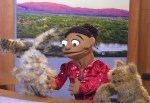
Dr. Begay and Jackson, co-writers of the show, developed the first 3-puppet characters and plan for many more. The pilot features Nanabah-a young Navajo girl, Gáh (Rabbit) and Dlǫ̀ǫ̀ (Prairie Dog) who will go on endless adventures learning about language, gardening, the environment and the importance of family values. Nanabah is fluent in Navajo and likes to teach children about life on the reservation with her animal friends and special guests. Children who want to learn Navajo will also be an important part of the show by interacting with Nanabah, her friends and storyline.
Dr. Begay’s research concluded there exists very little research in the area of Indigenous educational media. Currently media is a very powerful tool that can be used to teach. She is cognizant of the digital age we live in and the opportunities to utilize media to revitalize the Navajo language.
“Star Wars and Finding Nemo,” dubbed in Navajo, was a great place to start and it has garnered national exposure of our language. However, we need a show based on our own Navajo learning principals our ancestors set out for us to learn and live by. I don’t think a non-Navajo, non-Native or non-Indigenous person can do that for us, nor should they. We, as Navajo, need to produce this show ourselves, if we are to be truly sovereign,” added Dr. Begay.
Both educators, Dr. Begay and Jackson, of Naalkid Productions have been talking about this educational language project for about the past four years and still have a long way to go to finance their dream.
“With the support of Navajo TV Anchor Colton Shone, our team of Navajo artists, filmmakers, family and friends, this video pilot is a huge step forward,” said Jackson. “Our journey has just begun and the big next step is finding financial support to create a whole new puppet TV series.”
We aim to raise $50,000 with this project which will allow us to continue with pre-production and production aspects of making this digital media project become a reality. We need your help to save our language by teaching Navajo to our future generations.
Pre-Production: -Script writing for the pilot show -Puppet Development/Creation -Casting for puppeteers and other talent that will be on screen -Hiring of all key cast and crew
Production: -Locations and permits -Rental of Studio space -Equipment: cameras, sound, lights, etc. -Cast and Crew budget
Despite all the notes on this post, they’re still at $13,155 of their $50,000 goal.
and it’s a zeugma where one of the words is literal and one is metaphorical which is the BEST KIND
I didn’t know about zeugmas until just now! That is so awesome, everybody:
zeug·ma
ˈzo͞oɡmə/
noun
a figure of speech in which a word applies to two others in different senses (e.g.,John and his license expired last week ) or to two others of which it semantically suits only one (e.g., with weeping eyes and hearts ).
Mr. Rogers had an intentional manner of speaking to children, which his writers called “Freddish”. There were nine steps for translating into Freddish:
“State the idea you wish to express as clearly as possible, and in terms preschoolers can understand.” Example: It is dangerous to play in the street.
“Rephrase in a positive manner,” as in It is good to play where it is safe.
“Rephrase the idea, bearing in mind that preschoolers cannot yet make subtle distinctions and need to be redirected to authorities they trust.” As in, “Ask your parents where it is safe to play.”
“Rephrase your idea to eliminate all elements that could be considered prescriptive, directive, or instructive.” In the example, that’d mean getting rid of “ask”: Your parents will tell you where it is safe to play.
“Rephrase any element that suggests certainty.” That’d be “will”: Your parents can tell you where it is safe to play.
“Rephrase your idea to eliminate any element that may not apply to all children.” Not all children know their parents, so: Your favorite grown-ups can tell you where it is safe to play.
“Add a simple motivational idea that gives preschoolers a reason to follow your advice.” Perhaps: Your favorite grown-ups can tell you where it is safe to play. It is good to listen to them.
“Rephrase your new statement, repeating the first step.” “Good” represents a value judgment, so: Your favorite grown-ups can tell you where it is safe to play. It is important to try to listen to them.
“Rephrase your idea a final time, relating it to some phase of development a preschooler can understand.” Maybe: Your favorite grown-ups can tell you where it is safe to play. It is important to try to listen to them, and listening is an important part of growing.
Rogers brought this level of care and attention not just to granular
details and phrasings, but the bigger messages his show would send.
Hedda Sharapan, one of the staff members at Fred Rogers’s production
company, Family Communications, Inc., recalls Rogers once halted taping
of a show when a cast member told the puppet Henrietta Pussycat not to
cry; he interrupted shooting to make it clear that his show would never
suggest to children that they not cry.
In working on the show,
Rogers interacted extensively with academic researchers. Daniel R.
Anderson, a psychologist formerly at the University of Massachusetts who
worked as an advisor for the show, remembered a speaking trip to
Germany at which some members of an academic audience raised questions
about Rogers’s direct approach on television. They were concerned that
it could lead to false expectations from children of personal support
from a televised figure. Anderson was impressed with the depth of
Rogers’s reaction, and with the fact that he went back to production
carefully screening scripts for any hint of language that could confuse
children in that way.
In fact, Freddish and Rogers’s philosophy of
child development is actually derived from some of the leading
20th-century scholars of the subject. In the 1950s, Rogers, already well
known for a previous children’s TV program, was pursuing a graduate
degree at The Pittsburgh Theological Seminary when a teacher there
recommended he also study under the child-development expert Margaret
McFarland at the University of Pittsburgh. There he was exposed to the
theories of legendary faculty, including McFarland, Benjamin Spock, Erik
Erikson, and T. Berry Brazelton. Rogers learned the highest standards
in this emerging academic field, and he applied them to his program for
almost half a century.
This is one of the reasons Rogers was so
particular about the writing on his show. “I spent hours talking with
Fred and taking notes,” says Greenwald, “then hours talking with
Margaret McFarland before I went off and wrote the scripts. Then Fred
made them better.” As simple as Mister Rogers’ Neighborhood looked and sounded, every detail in it was the product of a tremendously careful, academically-informed process.
That idea is REALLY worth learning to talk to the kiddos. Mr. Rogers still has a lot to teach us–especially for our own kids.









 AngelMihe