Starting again on July 1st is my favorite online artist event: Art Fight! If you have OCs, and enjoy making and receiving art involving OCs, then I highly suggest you check out the site and set up an account!
For those who aren’t familiar with Art Fight, here’s a brief overview:
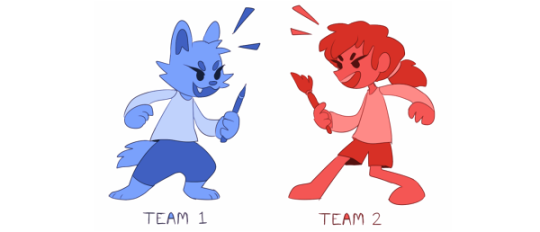
Each year, participating artists are split into two teams.
The main goal is to find any artist from the team opposite yours, and ‘attack’ them by drawing art of their ocs! Your team receives points based on what you create.
Artists that receive attacks can then ‘counter’ by drawing an OC belonging to the person who fought them, or pay it forward by simply attacking anyone on the opposing team!
The official about page with more in depth information is located here! There’s also a video format for this information that can be watched here!
Art Fight is a great chance to interact with tons of different artists, get to know the amazing OCs that others have created, and have a lot of fun making art! The art you receive is also very exciting; you never know who may attack you! Keep in mind, it’s all in good fun and any skill level is welcome!!
The event lasts a month (July 1st – August 1st), and the team with the most points by the end wins!
My account can be found here, if anyone feels like attacking me! I hope to see you there!!
and it’s a zeugma where one of the words is literal and one is metaphorical which is the BEST KIND
I didn’t know about zeugmas until just now! That is so awesome, everybody:
zeug·ma
ˈzo͞oɡmə/
noun
a figure of speech in which a word applies to two others in different senses (e.g.,John and his license expired last week ) or to two others of which it semantically suits only one (e.g., with weeping eyes and hearts ).
Mr. Rogers had an intentional manner of speaking to children, which his writers called “Freddish”. There were nine steps for translating into Freddish:
“State the idea you wish to express as clearly as possible, and in terms preschoolers can understand.” Example: It is dangerous to play in the street.
“Rephrase in a positive manner,” as in It is good to play where it is safe.
“Rephrase the idea, bearing in mind that preschoolers cannot yet make subtle distinctions and need to be redirected to authorities they trust.” As in, “Ask your parents where it is safe to play.”
“Rephrase your idea to eliminate all elements that could be considered prescriptive, directive, or instructive.” In the example, that’d mean getting rid of “ask”: Your parents will tell you where it is safe to play.
“Rephrase any element that suggests certainty.” That’d be “will”: Your parents can tell you where it is safe to play.
“Rephrase your idea to eliminate any element that may not apply to all children.” Not all children know their parents, so: Your favorite grown-ups can tell you where it is safe to play.
“Add a simple motivational idea that gives preschoolers a reason to follow your advice.” Perhaps: Your favorite grown-ups can tell you where it is safe to play. It is good to listen to them.
“Rephrase your new statement, repeating the first step.” “Good” represents a value judgment, so: Your favorite grown-ups can tell you where it is safe to play. It is important to try to listen to them.
“Rephrase your idea a final time, relating it to some phase of development a preschooler can understand.” Maybe: Your favorite grown-ups can tell you where it is safe to play. It is important to try to listen to them, and listening is an important part of growing.
Rogers brought this level of care and attention not just to granular
details and phrasings, but the bigger messages his show would send.
Hedda Sharapan, one of the staff members at Fred Rogers’s production
company, Family Communications, Inc., recalls Rogers once halted taping
of a show when a cast member told the puppet Henrietta Pussycat not to
cry; he interrupted shooting to make it clear that his show would never
suggest to children that they not cry.
In working on the show,
Rogers interacted extensively with academic researchers. Daniel R.
Anderson, a psychologist formerly at the University of Massachusetts who
worked as an advisor for the show, remembered a speaking trip to
Germany at which some members of an academic audience raised questions
about Rogers’s direct approach on television. They were concerned that
it could lead to false expectations from children of personal support
from a televised figure. Anderson was impressed with the depth of
Rogers’s reaction, and with the fact that he went back to production
carefully screening scripts for any hint of language that could confuse
children in that way.
In fact, Freddish and Rogers’s philosophy of
child development is actually derived from some of the leading
20th-century scholars of the subject. In the 1950s, Rogers, already well
known for a previous children’s TV program, was pursuing a graduate
degree at The Pittsburgh Theological Seminary when a teacher there
recommended he also study under the child-development expert Margaret
McFarland at the University of Pittsburgh. There he was exposed to the
theories of legendary faculty, including McFarland, Benjamin Spock, Erik
Erikson, and T. Berry Brazelton. Rogers learned the highest standards
in this emerging academic field, and he applied them to his program for
almost half a century.
This is one of the reasons Rogers was so
particular about the writing on his show. “I spent hours talking with
Fred and taking notes,” says Greenwald, “then hours talking with
Margaret McFarland before I went off and wrote the scripts. Then Fred
made them better.” As simple as Mister Rogers’ Neighborhood looked and sounded, every detail in it was the product of a tremendously careful, academically-informed process.
That idea is REALLY worth learning to talk to the kiddos. Mr. Rogers still has a lot to teach us–especially for our own kids.
someone: so what do you think is the solution to homelessness?
me, socialist:
Let homeless people occupy peopleless homes, build houses for use rather than exchange, 3D print comfortable houses in a day, convert corporate skyscrapers into housing and commercial malls into publicly-accessible community centers with living commons and entertainment
When you say it to people and they break
“But the money? … we can’t just? But, Money? We can’t just… help… people? Can we? The Money. We can’t just help people? Like that? We can’t just? Money?”
There’s more to it than free real estate.
A massive portion of homeless people are mentally ill, and many of those illnesses aren’t being treated. Homeless people who have been on the streets and had their illnesses untreated for most of their lives aren’t going to adjust super well to suddenly having a place to live.
We need to build safety nets. We need social workers and mental health care professionals to help the homeless.
Every person deserves a roof and health care. Those two things need to go hand in hand.
The Kingii is an emergency life preserver that you can strap right to your wrist that inflates in seconds and brings you straight to the surface of the water.
Fun fact: He made this up as the script said he’d pull out another cross from his pocket and after pulling out so many crosses in this film, Mr. Cushing asked the director if he could do something else and the end result was him making a cross out of two candle holders.
the way this sentence is phrased makes it sound like the fact that he is the donkey kong high score record holder is what makes him eligible to be the president of taiwan
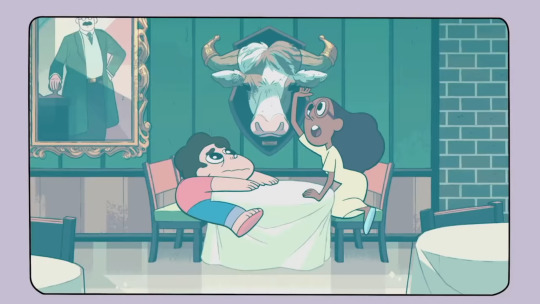
In “Full Disclosure,” we see Steven swipe through the photos on his phone, and there’s this one of Steven and Connie at a restaurant.
Notice the painting and the stuffed cow head. Stuffing and mounting an animal’s head is usually what you do with an animal that you’ve hunted and killed, not with domesticated farm animals that are slaughtered for their meat.
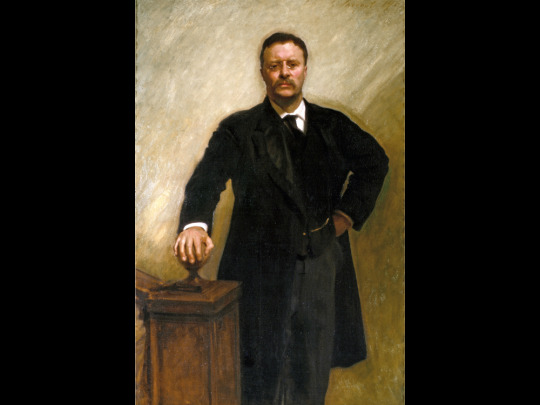
And that painting is based on a real painting of Theodore Roosevelt, who was (among many other things) a big game hunter.
And then there’s this line from Garnet in “Too Far:”
Are cows a wild animal that people hunt for sport in this universe?
Research has shown that Hand Talk is still being used by a small number of deaf and hearing descendants of the Plains Indian cultures.
“Hand Talk is endangered and dying quickly,” said Melanie McKay-Cody, who identifies herself as Cherokee Deaf and is an expert in anthropological linguistics.
McKay-Cody is the first deaf researcher to specialize in North American Hand Talk and today works with tribes to help them preserve their signed languages. She is pushing for PISL to be incorporated into mainstream education of the deaf.
((Quick note: This isn’t what American Sign Language or (ASL) refers to. We got most of our official signs and influences from the French.
Also fun fact: Every nation has their own form of sign language. It isn’t the same everywhere you go.))














 AngelMihe