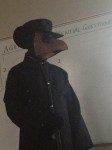
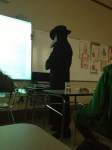
my fuckin health teacher came in as a plague doctor for halloween and proceeded to say nothing to us for the whole class. he did hit a few desks with a walking stick tho
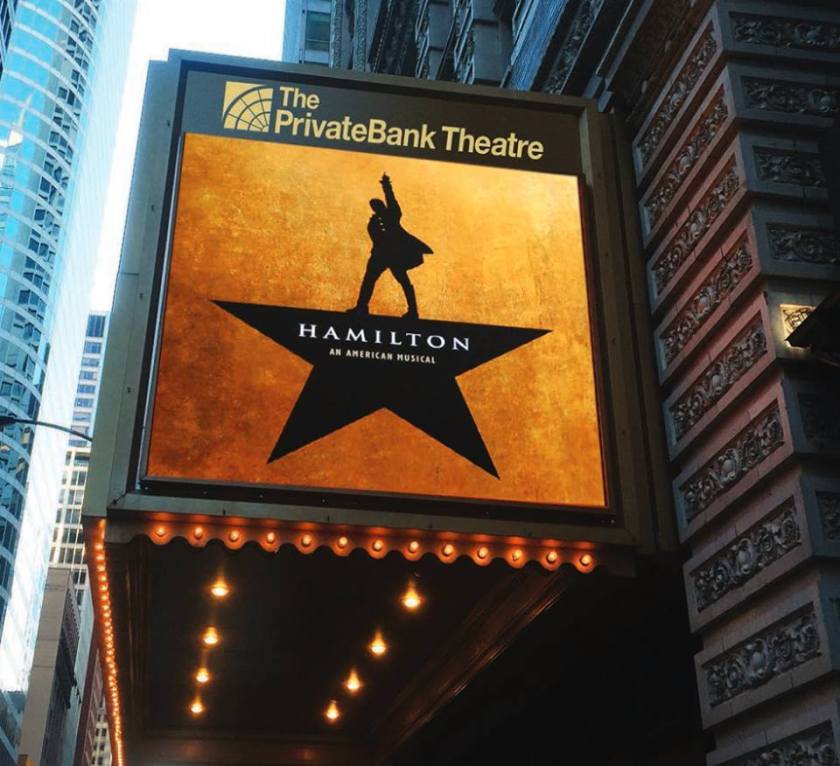
I completely agree, though. The women who are in the play are wonderful, nuanced, fully realized female characters that are actually key players in the story rather than props for the men to use and be characterized by. It’s great. But, like…I still want to see women outside of the lover/wife/girlfriend/mistress roles. I want women who aren’t talked about by way of their relation to the protagonist. I want women who FIGHT and LEAD and DEBATE and CONQUER.
I want a female narrator in the musical who is never played for sexy laughs, who gets to be a force driving the story instead of just standing to the sides singing about it. I want a poor, immigrant, probably-queer woman to rise above her circumstances thanks to intelligence and determination and ambition that she isn’t ashamed of. I want a female president and a Queen that no one defines by their gender. I want young women who get to go out drinking and railing against the system. I want girls who pick up their guns and fight for their beliefs. I want a boy to be the one left helpless by love for once. And a boy to be floored and fall for a woman’s intelligence. I even kind of want a boy to be the temptation/home-wrecker/victim of bad marriage. These would be pleasant changes.
Give me Lady Hamilton or give me death, basically. Give me a woman who screams obscenities and gets too excited to keep her mouth shut. Give me another woman who has learned that the world will like her better if she talks less and smiles more. Give me the most powerful, respectable, rational, loved character being a woman that everyone looks up to and needs to impress – a female General in war at all! Give me a girl gang of revolutionaries who turn into the most iconic figures in our nation’s history.
I just got back from the theater and holy shit, it’s been a very long time since a saw an animate movie this good. It may not be that way for other people, but as a person who has had to deal with ADD all their life, to have a character express the same frustration and fear that I myself have experienced personally made me cry profusely as a 21 yr old surrounded by a bunch of young children.
Because of my ADD I have:
• been fired from my job bc i wasn’t learning fast enough and i forgot orders and customers and when I was working too frequently • almost made me crash my car because i was looking at a dog in a car that i was passing in an intersection • lose valuable things instantly bc i forget that it’s in my hand then unconsciously put it down places • Wastes a lot of time bc i’ll go onto the internet intending to do the one productive thing and get distracted and end up scrolling Facebook or Tumblr for 3 hours before i remember what i went on the internet in the first place for
and probably a lot of other things I myself am not aware of..
Even as a 9 yr old going to see Finding Nemo, i came out of the movie theater going, “Im Dory! I’m Dory! I forget things too!” because, holy shit there’s a cartoon character like me who forgets everything. I’v used Dory to explain to people what I’m like at times, and she has been portrayed going through some of the same emotions that i experience bc of my mental illness (MI)
like, in both movies she gets angry and frustrated when she couldn’t remember something, closing her eyes and rapping against her temples, and shit man i’v done the same exact gesture, i hate it when i can’t remember something important or I get yelled at when I forgot to complete something bc it left my head the second they told me to do it.
I felt validated when I watched someone else express the same exasperation. I have developed a huge insecurity in myself because of this, and constantly worry how i will make a name for myself with the way I am, and this worry was voiced quite literally in the movie.
Dory had to go down some pipes in an aquarium to get to where she believed her parents would be, and the directions given to her by the other characters were clear and easy for most people to remember, but for Dory, she originally believed she would need someone else to come with her to remember the way, saying “I can’t go it there on my own, what if I forget?” and as I sat there watching this i thought to myself, well man, how many times have I told myself the same thing.
I have relied on people all my life to help keep me focused and often times I can’t get anything done if I don’t have someone keeping me on task. The writers had the characters, instead of invalidate her need by saying some cliche like, “oh, you’ll be fine.” recognize she had a problem and stay with her and yell directions to her through the pipes until she got to her destination.
The development team as a whole has my thanks for to be honest, they did their damn research. the sense of fear and being lost was so well portrayed in the film, you don’t even realise it until you look back. they visually explained the feeling of lost memories by having dory be in murky, unclear water in almost every instance of her being confused. They had everything in her environment fuzzy and out of focus and that’s exactly what it feels like when I get disoriented. Nothing around you makes sense and you feel lost and alone. It’s incredible that they could explain this so subtly yet concisely
a few other important points:
• honestly i cried at the scene where she found her parents bc they never gave up on her and found a way to work with her MI to help her find them, by laying out shells that were easy to follow that lead back to their home, they worked with dory on her terms and that’s what lead to them reuniting in the end
• (im bolding this bc this is important) the focus was not on curing Dory of her MI, but adapting to and coping with life with it, which was so huge to me. At the end she forgets that they’re playing hide and seek but talks herself through it until she remembers (a technique which i will be using from now on aswell) and I think of all the potential neurodivergant kids in the audience watching this and using this method and omg do i cry
• teaches people fish with disabilities are not helpless and can do things on their own (like when Nemo got himself out of the tube in the first film, and how Dory found her parents)
• The art, just, ugh, my little animator heart was so happy with the film in its entirety • it was honest to god funny (the seals) • it meant a lot to see a character like me living and functioning to their fullest despite inhibitions
long story short, i give it a ten out of ten, i would wait another 12 years just to see this movie again
This set of pistols was owned by the Marquis de Lafayette, who gave them to George Washington. Washington carried them through the Revolutionary War. For a time they were also carried by Andrew Jackson, before ending back up in the hands of the Lafayette family. In 2002 they were auctioned by Christies and sold for $1,986,000.
Lot Description
THE LAFAYETTE-WASHINGTON PAIR OF STEEL-MOUNTED “SADDLE” PISTOLS
Marked by Jacob Walster (w. 1761-c.1790), Saarbruck, France (now Germany), circa 1775-1776
Each with octagonal to round barrel of “Damascus” steel embellished with silver and gold wire inlay, the steel locks with chamfered edges and engraved borders, the tails engraved with a panoply of arms, all mounted on European walnut stocks with relief carved detailing holding wooden rammers with bell-shaped horn finials and iron cleaning tips, the first barrel markedWALSTER, the second marked A SAARBRVCK, both housed in an American Black Walnut case, 1830-1847; together with four accompanying manuscripts comprising an envelope addressed to Geo. W. Lafayette; a presentation document signed by J.L. Martin addressed to Geo. W. Lafayette, the verso inscribed by G.W. Lafayette (figs. 8,9); Madame Hennocque’s copy of M. Edmond de Lafayette’s 1890 will (figs. 10,11); a copy of the exhibition catalogue, “Les Etats-Unis & La France au XVIII Siecle” (Paris: Hotel Jean Charpentier, 1929) 17¾in. long (5)
Provenance
The Marquis de Lafayette (1757-1834) George Washington (1732-1799), by gift William Robinson (1782-1857), by inheritance Andrew Jackson (1767-1845), by gift George Washington Lafayette (1779-1849), by bequest Edmond Lafayette (1818-1890), son Antonin de Beaumont (d. 1910), nephew Marie de Beaumont (Mme. Edmond Hennocque), daughter Charles Marchal, 1958, by sale Charles Dresser, a French private collector Couturier Nicolay Paris (Auctioneers), Collection de Monsieur X: Tres Important Ensemble D’Armes a Feu et D’Armes Blanches du XIVe au XIXe Siecle, 19 October 1983, lot 124
Pre-Lot Text
Presented by the Marquis de Lafayette to George Washington during the American Revolution, these pistols stand as a supreme testament to the enduring friendship between America’s most revered historical figures and their struggle for American Independence. After just a quarter century following Washington’s death, the pistols were recognized as important icons of the New Republic and in 1824 were given to Andrew Jackson in support of his quest for the presidency. Not only did the pistols pay homage to the battlefield successes of America’s first and seventh presidents, but they also provided a symbolic link between military prowess and political leadership. With the return of the pistols to the Lafayette family in the mid-nineteenth century, the pair came to symbolize Franco-American ties and the mutual quest for liberty. Today, the pistols stand as one of the most important pair extant and the story of their illustrious ownership speaks to the ideals and aspirations of America’s founders.
GEORGE WASHINGTON AND THE MARQUIS DE LAFAYETTE
The life-long friendship between George Washington and Lafayette began in August 1777 at a dinner party in Philadelphia.1 Just two months earlier, Lafayette had arrived in South Carolina, a twenty-year old French aristocrat intent on fighting for the American cause. He later recalled,
The moment I heard of America, I lov’d her. The Moment I knew she was fighting for freedom I burnt with a desire of bleeding for her—and the moment I schall be able of serving her in any time or any part of the world, will be among the happiest in my life.
“
life-long friendship between George Washington and Lafayette











 AngelMihe