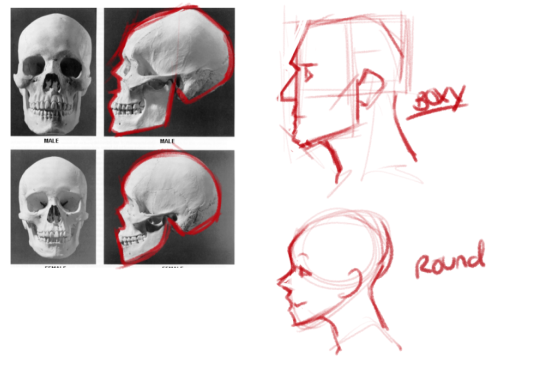
The most noticeable and useful part of the masculince face (at least to me) is the brow bone/ridge. On males it tends to be much more prominent and sets the eyebrows lower on the face, as well as the eyes further back in the sockets,
giving them a slightly sunken look.
The brow ridge is important bc on masculine faces it tends to be much more pronounced. It also can squash and stretch a lot to exaggerate expressions!
even on chubbier characters the brow should be clearly shown, since fat rarely accumulates above the cheeks.
tbh just play with rectangles. Sharpe edges and boxes shapes. The more burly and manly you want the character to be, the more sharp and defined the features should be. Also don’t be afraid to give your guys bigger noses, defined nostrils, thinner lips and bigger chins/jaws.
Instead of starting from an oval or circle shape when drawing faces, I almost ALWAYS start from a box. I’m not sure exactly when I made this change, but it was the start of my discovering my love of drawing manly men lmao. Really it’s just about finding the right proportions for the face you’re trying to create!
hopefully this will help yall in your pursuit of drawing dudes.
An intense bloom of Pycnoporus sanguineus, a reishi lookalike that has also seen traditional use as a medicine. Aboriginal Australians reportedly chewed this fungi to cure mouth ulcers and other oral disease. Extracts from this mushroom have industrial applications in dye degradation.
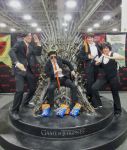
Our Penguins of Madagascar group for SLCC! It seemed only natural to take a picture on the Iron Throne. (Kowalski and Private don’t have tumblrs, so far as I know)
TIL that a cat once co-authored a physics paper. In 1975, a physicist had just finished writing a paper and was ready to publish but realized that he had used ‘we’ instead of ‘I’ throughout, despite being the sole author. Not wanting to edit the paper, he listed his cat, Chester, as a co-author.
Ok but the best part is, physicists loved the joke. When people called the author’s university and he wasn’t available, they’d ask to speak with the co-author instead. The author issued a limited number of copies of the article signed by both authors. (Chester’s was obviously a pawprint.) And to this day, physics papers will often have F.D.C Willard (Felix Domesticus, Chester Williard [Willard was the author’s father’s name]) mentioned in the footnotes thanking his “useful contributions to the discussion”.
















 AngelMihe